Showing posts with label copywriting. Show all posts

Thursday, 12 June 2014

Proofreading: What's it all about? (Part 1)


The Copy Collective's resident wordsmith Maureen Shelley begins her new blog series: "10 Simple Steps to becoming a successful published author."

Today she unpacks the curious concept of proof reading.


What is proof reading anyway?

Proof reading is when a manuscript or other written work is submitted for checking of semantics, grammar and typographical errors.


This can be done by a proof reader or editor or, if you can't afford a human, you can use online programs such as Grammarly . We use Grammarly to check for originality to ensure that work submitted for proofing or editing by us isn't plagiarised by the writer.


So what are you trying to say?


What programs such as Grammarly can't do for you is actually understand what you are trying to say when your subject and object aren't clear and then to suggest appropriate edits. 


If as a writer you can't even afford Grammarly, then you should at least use the spell checker in your word processing program.


Tips for top-class grammar when using Word:

  • Set the language to your choice first - Australian English, UK English or US English - they will all give slightly different suggestions for spelling of words. Then do a "select all (Control A in Word on a PC) and then F7 for a spell check. Do this repeatedly - you will be amazed at how many errors you find.
  • Turn on recommendations for grammar as well as spelling. It will come up with a few suggestions that you will need to ignore but should find most glaring errors.

June is Author's Month to celebrate the launch of Red Raven Books. Red Raven Books is the publishing and imprint arm of The Copy Collective. Find out how we can help you today.

Monday, 2 June 2014

The Red Raven flies with “Hope in 60 Seconds”


Guest Blogger Graeme Innes gives a bird's eye view from yesterday's book launch of “Hope in 60 Seconds”, Red Raven Book's first title in print.


Crows Nest is a great place from which to launch a new bird.  So Northside Community Church in Crows Nest, NSW provided an excellent launch-pad for Pastor Graham Agnew's first book, Hope In 60 Seconds.


It was fitting that the driving force behind the launch, boosting the book into the stratosphere of sales, was new publishing house Red Raven Books, the imprint arm of The Copy Collective.


When I endorsed Graham Agnew's (or GA to his friends) book I said:
“A super-charged buzz is on every page of Graham Agnew’s Hope is 60 Seconds. The messages throughout this book will renew your hope. I’ve been riveted by his sermons, loved his radio messages, and his book will make a permanent appearance in my daily reading.”


In launching the book, world-renowned author and speaker Michael McQueen commented the book contains 100 stories each with that vital ingredient of hope. He smilingly encouraged those at the launch to buy and read the book, as one of the stories could be about them.


I met a man walking away from the launch with five copies of the book in his hands.  In response to my question about his bulk purchase, he said "I've bought five of these books to give to five kids.  If one kid reads one story in the book, and it changes their life, it will be $100 well spent."


Hope in 60 Seconds can be obtained in print through Graham Agnew's website: grahamagnew.com. It will also be available as an E-book in July 2014.

June is authors month at The Copy Collective. We will profile new titles published by Red Raven Books; the publishing and imprint arm of The Copy Collective.


Tuesday, 8 April 2014

Guilty by Association - Are you mindlessly sharing content you haven’t even read?


The Copy Collective’s Jim Butcher lifts the lid on lazy sharing that could cost you ‘Likes’…


Isn’t it annoying when your personal Facebook or Google+ newsfeed gets chock full of mindless junk?
I’m not just talking about your cousin rejoicing in their latest Farmville conquest or your mate inviting you into the terrifying world of Candy Crush Saga. I mean the stuff companies whose Facebook pages you’ve liked, start sharing things with you that they think you’ll find “interesting”.

It’s the result of firms sharing content to improve and maintain their social media presence but not really thinking about the quality of their newsfeed.

One poorly chosen shared article from them and ‘click’ they’ve lost a reader and a potential customer. It’s something you should be very conscious of when sharing content with your readers too.
Too often people share content that they think is what their readers want to know about, but they haven’t even read the article.

To prove the point, National Public Radio (NPR) published this brilliant prank post on Facebook about why Americans don't read anymore. 


After the headline and title image, a quick message asks all people who have read thus far to simply like the post and not comment and see what happens.

The comments that follow are well worth a read and just goes to show people really aren’t paying attention to what they’re interacting with online.
 
To make sure you’re sharing the right content, here’s a quick checklist of other important criteria to consider each time you share something with your readers online:
  • Does the hyperlink work? One of the most frustrating moments is when the lead-in to a piece has done its job but when you go to click through, the link doesn’t work.
  • How old is the article? Even if the content you’re sharing is evergreen, make sure it’s not too old. Anything more than a year old loses traction. If it’s a stats-based piece, it cannot be more than six months old.
  •  Is the article any good? Make sure it’s well written and interesting. Check it’s not full of bad spelling, poor punctuation or grammar.
  • Is the article correct? Don’t share the article if it’s wrong, controversial or - even worse - off-brand.
  • What does it offer your readers? Your readers will want to take something away with them from the article. Make sure what you share provides this.
  • Would you follow you? Think about this as you share more and more to your curated content portfolio. People are likely to look back at what you’ve shared in the past.
  • Remember, people trust your shares. Sharing poor quality content can adversely affect their trust and therefore your traffic.
As founder of ProBlogger - a publishing and information resource company - Darren Rouse says: “in the midst of the strategy and tactics, don’t lose sight of the people on the other side of your content.”          


Thursday, 9 January 2014

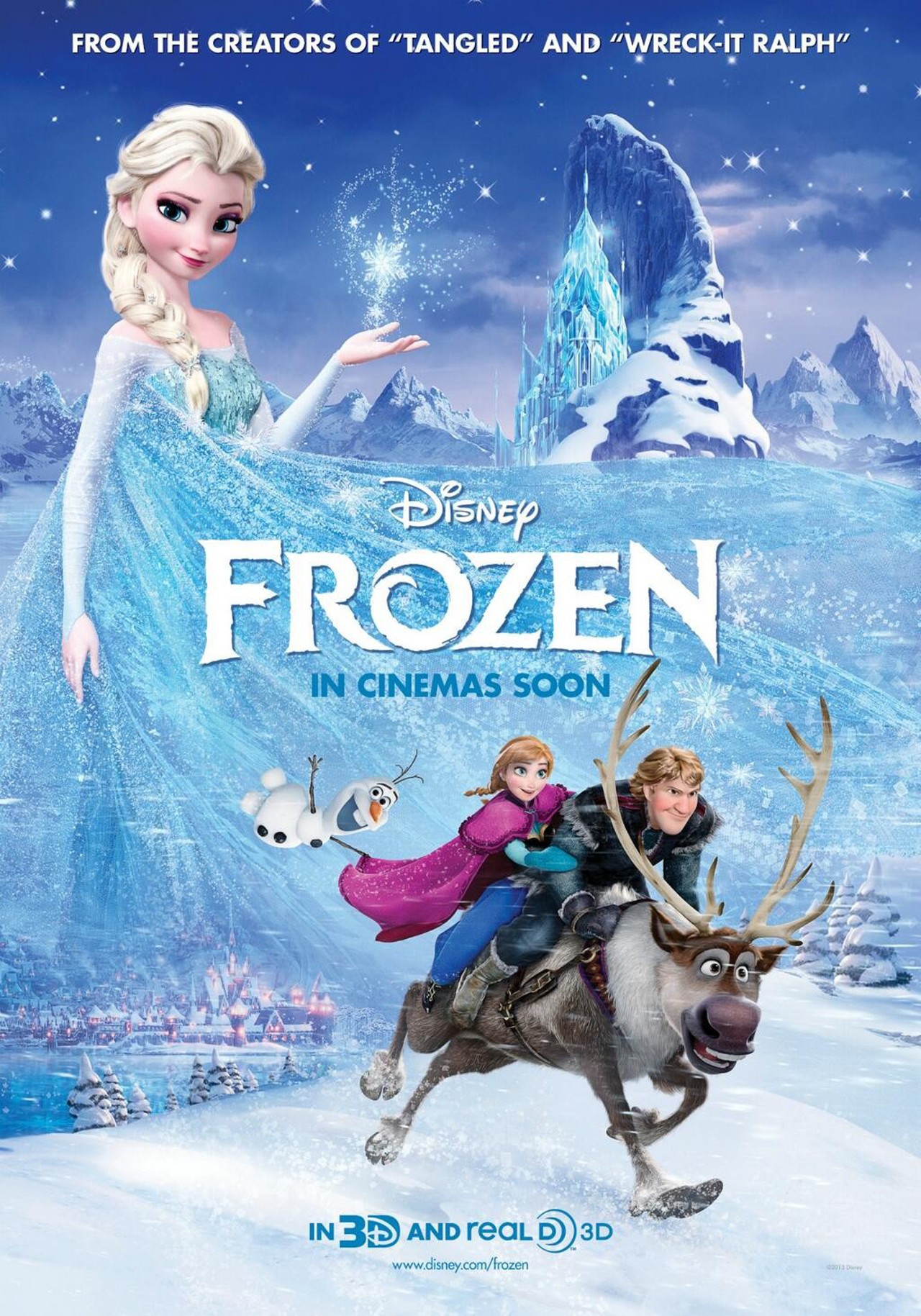
Disney, disability and Frozen

Frozen charts feminist territory and a the glimmer of a more enlightened view of people with disabilities for Disney writes Maureen Shelley.


Despite the singing (I lost it when the snowman started warbling a ballad to summertime), Frozen is a stand out in the Disney movie archives. The plot – loosely based on Hans Christian Anderson’s The Snow Queen – has two beautiful young princesses face the requisite number of obstacles before they discover the meaning of true love. So far, so Disney.
What’s different is that true love IS true love, the sisters are agents of their own destiny, the issue of disability is taken out and examined implicitly in a shockingly different way for Disney (more on   that later) and the plot is intricate, complex and engaging.

True love

For Disney true love has been, until this century, what we in the real world call infatuation or lust. In Frozen, true love turns out to be the love that two people have for each other and is based on years of relationship, shared memories, selflessness and self –sacrifice. It is based on more than a few hours of acquaintanceship or a single kiss. So not Disney.
Further, one of the beautiful princesses falls for a bad boy who is prepared to kill her and her sister to win a kingdom for himself. The princess sees the bad boy for what he is and doesn’t fall in love on the rebound. Disney, it seems, has lost the plots on which it has relied for about 90 years.

Feminism

Peg-Leg Pete threatens Mickey (C) Disney
Yes, these two princesses are beautiful, size 6, talented (singers at least) and privileged. Yet, in Frozen the young women get to do the rescuing as well as being rescued. They get to make decisions for themselves and implement them. They order people about and have their orders followed (I think that’s the princess bit but it’s a start). These women do more than stand around singing.
Although the animators at Disney still have foot-in-mouth disease where women are concerned (it’s hard to animate them, make them do things and keep them “pretty” said one), at least Frozen sheds a glimmer of light on the equality of the sexes in Disney. It doesn’t stretch to the women being plain, ordinary, lacking in privilege or, you know, with a job or anything but it is progress.

Disability

Frozen was shown in the session we attended with Get A Horse – a short cartoon based on old footage, reworked for the digital age. The villain in Get A Horse is Peg-Leg Pete. Pete’s name is a dead giveaway – he’s a person with a disability. He’s the only person with a disability in the cartoon and he’s the villain. He’s a pretty nasty character and he has Mickey Mouse (voiced by Walt himself) to contend with, so there are no prizes for guessing who wins the day. Mickey ensures that Peg-Leg Pete, who is a would-be thief, is repeatedly injured by taking advantage of his clumsiness that results from him only having one leg. Now, apart from the unsympathetic treatment of Pete, Get A Horse is a nasty little story, so we won’t dwell on it. However, it does show Disney’s (sometimes very unsympathetic) treatment of characters with disabilities.
Disney has depicted a range of characters with disabilities in Princess films over the years, namely
·         Seven men of short stature in Snow White (achondroplasia or dwarfism is a recognised disability)
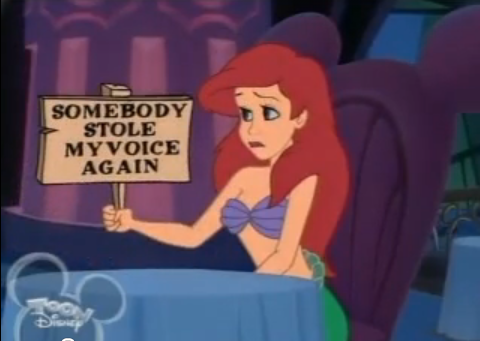
Ariel - The Little Mermaid (C) Disney
·         Ariel in Little Mermaid (at times she can’t walk and at others she can’t talk)
·         Aurora in Sleeping Beauty (she’s in a coma for much of the film and may have brain injury)
·         the Beast in Beauty and the Beast has a debilitating disease that causes dysmorphism or physical malformations
·         Pocahontas believes she can talk to animals, commune with spirits and understand unknown languages, which makes her a savant, possibly on the autism spectrum or she may be delusional
·         Cross-dressing Mulan is very clumsy and may be living with ataxia, a movement disability
·         Tiana in The Frog and The Princess believes she turns into an animal. This may be psychiatric therianthropy or delusions associated with schizophrenia.
·         Rapunzel in Tangled clearly had a form of polycystic ovarian syndrome that resulted in excessive hair growth
·         Merida’s mother Elinor from Tangled and her brothers Harris, Hubert and Hamish all turn into bears – a similar dilemma to Tiana in The Frog and The Princess. These may be just delusions created by drug abuse but they also may be symptoms of mental illness.
These disabilities are usually “inflicted” on the characters by a “wicked witch” or a “curse” and are often resolved (cured) at the end of the film by true love (a different form of magic).
Yet it is in Frozen that we see Elsa, the character with a disability that is both a “power” and a “curse”, as being the subject of two very different treatments as a result of her condition.
Elsa has a condition that makes things she touches become frozen, which can be a good thing – she can create ice castles in the air – and causes problems (she accidently puts ice into her sister’s brain).
Elsa the Good, (C) Disney
Her parents’ response is to lock her away, to not let anyone see her, to have her learn to control her emotions and to be a “good girl”. She and her family become very isolated.
It reminded me of how families with children with disabilities would put them in institutions, send them to special schools (we don’t see how Elsa was schooled) and generally cut them off from mainstream society. Both Elsa and her sister, Anna, suffer loneliness as a result of Elsa’s isolation – much in the way that families with members who had a disability did in the past.
Elsa runs away to the mountains and embraces her condition and the power it gives her. Interestingly, when she does so, she becomes much more womanly. She sheds her “good girl” clothes and walks with a wiggle; she creates a beautiful palace and becomes more queen-like.
However, she is even more isolated than when she was shut in a room by her parents. In her room she could talk through the door to her sister or the servants. In the ice palace, she is alone except for the snowman and a Yeti-like beast that she creates. Clearly, in the Disney cosmos, disability is a reason to isolate people in the most extreme way.
Anna, when she learns of Elsa’s “power” (curse) wants to investigate what can be done, she wants the condition out in the open and she wants to use relationship to address it.
It seems odd to me that Elsa’s parents don’t ever try to get help for her to learn to control her emotions (psychiatric treatment) so that she can manage her condition. They seek advice from a troll when she is a child but no further intervention is sought until she comes of age.
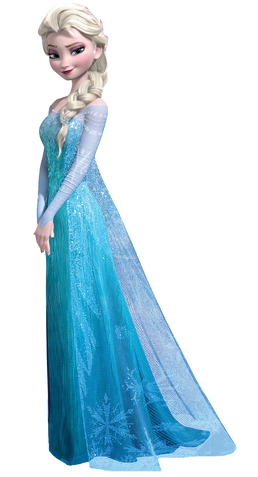
ElsaPose
Elsa - the Snow Queen (C) Disney

The intersection of sexuality and disability in Elsa’s life is like a double threat and echoes the experience of many women with a disability. The disability may be tolerated when they are children but when they become women the disability needs to be dealt with more strictly. In extreme situations (in real life) this has resulted in many women with intellectual disability being sterilised. In Elsa’s case, she has to run away to become a woman but is seen by some as a “monster”.
Anna works to get Elsa to return to the city so that it can be removed from the permanent winter she accidently created by letting her emotions loose. By Anna’s self-sacrifice – she takes an injury meant to kill Elsa – Elsa’s heart melts and she is now able to control her condition. She uses it to create beauty.
Through the self-sacrificing love of her sister, Elsa is able re-join society, live in the city and be crowned queen. She is no longer isolated, her condition is known to everyone and the people are indulgent of her and proud of the way she uses her power to create beauty.

However, Elsa doesn’t win the ultimate Disney prize that of a relationship with a man. Maybe, that is a stretch too far for even this new 21st century, Pixar-driven Disney universe.

Thursday, 26 December 2013

How to be a freelance writer people want to use again and again

The Copy Collective's Andrea O'Driscoll knows what it takes to be a good writer.
Be a shining light in the freelance world
Being a good freelancer isn’t just about being a good writer. Sure, having some talent is a great place to start, but there are a lot of gifted writers out there who barely make ends meet. Why? Too often it’s because they don’t have the rig
ht attitude. People don’t want to work with a tortured artist, they want to work with someone who is reliable, honest and professional.
So what exactly does that involve? Here are 10 tips for becoming the kind of freelance writer that everyone wants to work with.
1. Accept feedback
Repeat after me: feedback is my friend. It might not always be what you want to hear, but feedback will make you a better writer. Editors are busy people. If one has taken time out of his or her schedule to discuss your work, it’s a compliment, not a criticism.
2. Don’t take it personally
 Yes, I know you put your heart and soul into every word, but that doesn’t make every criticism a personal attack, or every rejection an insult. Editors make client-focused business decisions more often than they make personal digs.
3. Turn copy around
In other words, get the job done. It’s no good leaving half-written jobs languishing on your laptop while you wait for inspiration. You need to finish what you start.
4. Be available
This can be a tough one. Every freelance writer has a horror story or two about taking on too much or having to work through a family holiday. But the fact is if you turn down too many jobs, people will stop asking.
5. Do what you say
People need to know that you can be relied upon to deliver on your promises. Be a (wo)man of your word.
It’s not just about you. If you miss a deadline it affects everyone – designers, proofreaders, editors and (God forbid) clients. That’s not going to make you popular.
7. Be flexible
Everyone knows that things can change. It’s a fact of freelance life.
8. Your client has a client – so make them look good
You need to be on their team. If their client makes a last minute change, you need to help accommodate them. If asked, you need to say nice things. And of course you need to maintain consistently high standards.
9. You are precious, but don’t be precious
Once you’ve filed your copy, you need to cut the cord. If an editor decides to change ‘effervescent’ to ‘bubbly’ despite your careful word choice, let it go. They know what they want better than you do.
10. Ask questions, but accept the answer – even when you don’t like it

It’s good to ask questions, but not everything is open for debate. Once a decision has been made, accept it and move on.

Friday, 4 October 2013

Writing for the Web

Your digital audience is internet-savvy and time poor. So don't waste their precious time (and yours) with long-winded explanations of why they should buy from you.

  • Make it short and sweet.
  • Make it visual.
  • Give them something, and then
  • Go home.

Here's a present for you

If you like our infographic, then download the PDF here

If you like our infographic, then see more work by this talented Chicago-based graphic artist 

Wednesday, 4 September 2013

What will the results of the Federal election bring you, regardless of who wins government this weekend? The Copy Collective's Pauline Lockie and Jim Butcher consider what opportunities may come your way.

In the world of politics, there is no second place. There’s either winning Government or a long period in limbo. For the rest of us it is pretty much the same: success or oblivion.
With the finish line of the 47th Australian federal election in sight, there’s an opportunity, which organisations such as yours may use to your advantage. It’s time to ask yourself if your organisation is ready to make the most of post-election opportunities for campaigning, mobilising supporters and establishing yourself with new audiences.

In the days and weeks after the election, it’s essential for your organisation to communicate its action plan for the future. You need to align yourself with political agendas or position yourself to be the one that acts on issues that peoplecare about regardless of the government’s or shadow cabinet’s advocacy.

Either way, it’s crucial that you communicate your stance, and fast.

It’s not an easy task. Key to your campaign will be how specific you are with your ask. Saying you just want to approach - for example - environmental issues isn’t enough. Which issue? What needs to happen? Why? How? Who’s involved? And most importantly: What do you want your supporters, clients or customers to do about it?

The Asia Pacific arm of Greenpeace runs targeted campaigns that are very successful. Pic: Courtesy Greenpeace AP.
Greenpeace always does this really well and a recent example is their Great Barrier Reef campaigns. They target a specific politician about a specific issue threatening the Reef. They clarify the solutions the MP needs to implement. And they make it 100% clear how their supporters can take action to achieve these goals.

Here are some of the other possible policies (or changes to policy) that could affect you post-election:
·         National Disability Insurance Scheme
·         Education funding (Gonski)
·         Refugees
·         Marriage equality
·         Conservation and the environment
·         Welfare, and
·         Funding for the arts
But it’s all about how you ask for these things. It’s an art form. And if you’re not completely committed to producing perfect, persuasive copy, then your mission may not only fall on deaf ears, it is likely it will fall into silence too.

 It's all about quick response, and you need an expert at writing and designing online projects in short time frames. You need a campaign that is easy for people to respond to, and which may cover eDMs, social media, targeted ads, website copy, fully-integrated digital campaigns, and more.

So the question is not who will win this election, it’s will you be off the blocks and running when it’s through?

Friday, 28 June 2013

My favourite punctuation mark

Correct use of colons and semi-colons is good for showing-off. The comma does a fine job separating things. Brackets, dashes and the ellipsis all have a role to play. The exclamation mark adds drama.

Yet my favourite beast in the punctuation zoo is the humble full stop. Or, for Americans, the period. Some call it a dot.

It may be tiny. Sometimes it is hard to spot. On the printed page it uses next to no ink. On your smartphone screen it may be a single pixel.

The smallest punctuation mark is the most powerful. That’s because it ends a sentence. At the other end you’ll find a capital letter. Between the two you should find a group of words that hang – hopefully logically – together.

Better sentences contain a single idea. The best ones are also short.

Academic writing, poetry and literature have their own priorities. Most other types of writing work best when sentences don’t ramble.

This means lots of full stops. They make writing easier to understand. They help get ideas from one person to another quickly and efficiently.

Short sentences are clear. They are more likely to be unambiguous. They don’t need advanced reading skills. Nor do they need English as a first language. If you want to reach the biggest audiences you can’t go wrong with short sentences.

Don’t let people tell you short sentences are patronising. They can be powerful. Take the shortest sentence in the Bible. Jesus wept. Those nine letters pack a hefty punch.

‘Staccato’, ‘tabloid’, ‘simple’. Some say these words as if they are bad things. For me they are a sign of a writer who knows their art. I aim for ‘spare’, ‘tight’, ‘efficient’.

So the next time you put pen to paper aim for the maximum number of full stops. You’ll make me smile. 

Tuesday, 2 April 2013

Wordle: 60 Likes
You helped us get there. Thanks! Turning 60 is a big deal in most people's lives and hitting the magic 60 mark for The Copy Collective is something we are thankful for. It means that 60 people like what we do - or 1+ it! - and that 60 people are interested enough to make that "liking" public. That's commitment. We promise not to spam you or cyber stalk you. Hopefully, most of what we say will be meaningful and helpful to you - the people who like us. But today - we just want to say THANKS! - and yes, we know that's shouting but we want you to be clear on our message; we are grateful. Thanks.

Wednesday, 13 March 2013

What Can Britney Teach My Charity About Marketing?


What could single mother Britney Spears, who has admitted to “dabbling” in drugs and is renowned for going out without her knickers, have to teach the charity sector about fundraising?

1. Baby One More Time - Britney knows her product really well; it is herself. A talented singer, she was a teen icon who defined pop music in the late ‘90s. Baby One More Time sold 1.4 million physical copies and more than half a million digital copies for the 16 year old. Lesson one is – be very good at what you do.
2. Oops, I Did It Again – Still rocking her “sweet 16” persona, Britney shows with her second album that she could pull off the same stunt – twice. So lesson two is – just because you’ve used a tactic once doesn’t mean you have to “refresh the brand” straight away. You can have success doing the same thing - again.
3. I’m A Slave For You – Britney decides – after turning 19 and three headline-laden years in the industry –to show that she’s an adult and a strong, mature singer with real ability. So lesson three is – if you have used the same formula for a while, consider how you can branch out and make the most of what you have.
4. Toxic –Britney’s 2004 hit showed that she could deliver a seriously good tune, which became a dance anthem – reassuring her fans that she had what it takes to be a star and not just a diva. So lesson four is – despite your challenges and failings/failures pick yourself up and do what you are good at – now is not the time to be a fundraising diva, it’s time to deliver.
5. Gimme More –That’s a fundraising tagline that you probably won’t be using – at least put as baldly as that. However, Britney was ramping up her raunch factor in 2007 and capitalising on her strengths. So lesson five is – now is the time to turn up the dial on your fundraising efforts. If you need more, ask for it.
6. Piece of Me – December 2006 was disastrous for Britney – her parenting was questioned, her fan site closed, she was voted worst dog owner, and she broke up with Paris Hilton. Apart from that she kept forgetting her knickers. Britney turned to music in 2007 and she made lots of money. So lesson six is – ensure your donors know you don’t just want a piece of them – let them know that you value them. It’s time for some donor care.
7. Womanizer – a naked Britney in a steam room? Seriously, I can learn from this? “I know just what you are,” Britney sings – she gets it in one. So lesson seven – do you know just what and who your donors are? Segmentation –also known as ‘community building’ –works.
8. 3 (That's the name of the song, just '3') – After 11 years in the top searches on Google and with more than 4 million followers on Twitter (in 2009), Brittany decides to go back to basics - 1,2,3.

  1. The focus is on her
  2. She sings a catchy tune, and
  3. She puts her best ‘foot’ forward. 

So lesson eight – what are your charity’s three basics in fundraising? Identify them, stick to them and promote them.
Britney Spears on a downward trend
9. Hold It Against Me – Britney has two personas by 2011 – the sweet innocent that fans loved when she was 16 and the raunchy diva of 2011. She offers up both in the lyrics and music video with this hit. She has also learned the art of merchandising and cross promotion and the video features her perfume and make up. So lesson nine is – are you merchandising, do you cross promote and are your charity’s personas tailored to each community?
10. Till (sic) The World Ends – even Britney needs a good copywriter, as the title of this song shows (it should be ‘Til as in ‘until’, not Till – which is a either a cash register or something farmers do to soil). In this post-apocalypse anthem Britney is still singing and, with more than 113 million hits on this December 2012 video, why wouldn’t she be? So lesson 10 is – while your hits might be trending downward (just like Britney’s), it’s not over until the world ends. See what a good copywriter can do; let us help you trend upwards again. Come visit us here or there or what about this place?, or even somewhere else or maybe, even here.

Thursday, 21 February 2013

The Copy Collective logo with word grid
And words are all I have to take your heart away . . .