Showing posts with label marketing. Show all posts

Wednesday, 10 September 2014

Marketing your book (Part 9)

You have written your book, it's been published in print and you have 700 copies on a pallet in the garage plus you've just listed the book on Google Play, Amazon and in iBooks. Now you are waiting for the sales and royalties to roll in - right? Ah, no - that's not how it works.
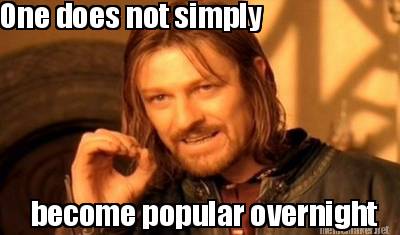
Picture of Boromir from The Fellowship of the Ring with the text "One does not simply become popular overnight".
"One does not simply" meme. Source: http://www.mememaker.net/

As I tell our authors, writing and publishing your book is the easy bit, now the hard work starts with marketing. 


Back in the day, authors had publishers who would take them on publishing tours and spend $30,000 on a marketing plan for each release. And that still happens. There are authors who have those services available to them. However, these days most authors do their own publicity, especially if they want to make any money.

If you've received a $15,000 advance for a 10,000 print run from a major publisher, congratulations and we'll say good bye here. If you're still with me, let's get down to taws.

I'm assuming you've taken my advice and have a good author photo, a readable blurb for your book and social media assets developed. If you don't have social media assets let's start with the basics.

Social media assets

You need a website dedicated to your book, a Facebook page, and a Twitter account as a minimum. Depending on the book (cookbooks - think Pinterest, young adult - think Tumblr, business - think LinkedIn) you will need other assets. Stay with the mainstream social media mentioned above and/or Google+, Instagram, and YouTube because your time is limited. 
You can only manage a certain number of accounts well with the time and resources you have.

Consider using Hootsuite to manage your social media so that you can automate the scheduling of your posts. Use the strengths of your social media assets: share links on Twitter (they get a greater click-through rate), pictures on Facebook and videos on YouTube.

Once you have your assets, you need to maintain them. Try to tweet every day, Facebook once a day, update LinkedIn twice weekly and blog once a week. Add your Twitter feed to your website, so the content is constantly being refreshed (Google loves fresh content).

Add a Google Analytics code to each page of your website so that you can track and analyse your traffic easily.

The great news about all these assets is that they are free to create and operate. You only start adding costs once you start advertising, which I recommend but only once you have all your social media and other digital assets working for you.


Social media is everywhere - so you can be too.


Other digital assets

As an author there are some great sites devoted to books where you can create an account and get your books reviewed. In fact, there is an entire industry devoted to just that. goodreads is essential. It's free to create an account and you can add that great author photo, your bio and write a blog that could reach 30 million book lovers. There are other sites but goodreads is a great place to start. 

Your book's website

Your website is a salesperson who works 24/7 and doesn't take sick leave. It should be as slick as you can make it. Have a look at the sites of other authors in your genre for what works. Huffington Post surveyed its readers for their favourites and never underestimate the power of independent bloggers and reviewers - they will link to your website.

Blogging

Now that you are an author, you should make it a goal to write a blog post each week. If you have a WordPress website or blog site, you can put the goal in the settings and it will remind you to post a blog via email.

Content for social media and blogs

Clearly, if you have speaking engagements, book signings or launches you will write about these. You should also have a friend take photos of you signing books and speaking, so that you can include them in your posts. 

But what happens when you run out of ideas? Firstly, sit down and write out 10 blogging topics and set yourself the task to write one a week. Next, use the tools built into HootSuite and other sites to curate content for you. Enter a list of key words and it will suggest content for your to post from others. Follow key accounts on Facebook and Twitter and repost and retweet their content: it gives you content for little effort and the other account may return the favour and share something of yours.

For your blog topics think about things that will interest your readers - where did your characters come from? How did you work out which topics to address in your business manual? What is it like being an author? People are interested in your story. So tell a story about writing the book or how you became an author or what prompted you to write the book. Use storytelling, similes (phrases that use the words 'like' or 'as'), active language, metaphors and detailed examples. These techniques will make your posts more interesting. 

Speaking engagements

Black and white image of a typewriter with the text "meet the author".
Libraries often host "Meet the author" events.
Source: www.eastlakelibrary.org/
Offer to speak at your local writers group, editors society, service club or any other group you think might be interested in your topic. Contact your local council about "Meet the author" events at public libraries.
Visit your local bookshop and see if they will have you speak at one of their author lunches. Browse your local Meetups for groups that may like a guest speaker. 

Try and line up at least 12 speaking engagements a year. Aim to sell a set number of books each time you sell. After a few speaking engagements, you will be able to gauge how many books you sell on each occasion. If you sell 20 books each time you speak, then you will need to have 35 speaking engagements (almost one a week) in a year to clear those 700 books out of the garage. 

Join societies

In every state in Australia there are societies of authors and publishers, writing centres, book clubs and writers festivals. Get involved, take a stand or stall at any relevant conferences where you think your book might sell.

General publicity

Write a media release for your book launch. Send it to your local paper as well as the major metro dailies as well as bloggers and relevant sites for your topic. Provide professional photographs of you and images of your book cover. Use a wire service such as AAP Medianet or PRWire to distribute your release (this will cost money). If you don't have a budget for a paid service use one of the free PR newswire services. At the very least, get your release indexed by Google News

Knock on doors

It's not very likely but you can try the direct approach to getting your book in bookshops. Try Readings, Gleebooks, Dymocks (try your local Dymocks first), and independent book stores (check the directories hosted by Australian Independent Bookseller and Danny Yee).

Use a distributor

If you have a print book, send your book to a distributor. Dennis Jones & Associates is the most used service in Australia but you can also try Macmillan Distribution Services, Australian Book Group and United Book Distributors. If you have a specialist topic  that you can approach (like Koorong for Christian resources or Co-op for tertiary education).

If you have printed your book through a print on demand service such as Lulu or Blurb, they too will have distribution services that you can pay for.

Marketing calendar 


Now you have all your assets developed, your distribution plan in place and a few dates for conferences and speaking engagements plus all those commitments to tweet, post, and blog and vlog (video blogging). Organise all your commitments into a Google Calendar (another free asset). Input your daily, weekly, monthly and ad hoc commitments. You will soon find that you have something penciled in for most days/weeks.

Stylised graphic of Google Calender.
Google calender synchronises across multiple platforms and devices. Source: blog.smartvisite.com/

That sounds daunting but if you aim to be a full time writer, then you'd better get used to putting yourself into the public gaze to vend your wares. 

And the best-selling tactic?

The very best thing you can do to sell your first book, is to write and publish your second. Think of it as renewing your product line. We all want the latest, the freshest and the most up to date, however, if we can get a bargain we might very well buy an older model. Game of Thrones didn't become a hit in the first season. Some people are catching on now and Season 1 is selling well in iTunes.


If you've got this far, congratulations! You are well on your way to being a successful published author. We wish you all the very best and hope that you become a household name or at least sell all the books you have printed.

Red Raven Books is the publishing and imprint arm of The Copy Collective. Find out how we can help you today.

Wednesday, 18 June 2014

Book Cover Design and Editing: How to create a good-looking book that sells (Part 3)


Maureen Shelley continues with Part 3 of "10 Simple Steps to becoming a successful published author" series, on crafting a cover as good as your content.


Although we say "don't judge a book by its cover" everyone does. That makes the selection of the design for the cover of your book the most important decision you will make - apart from choosing the title.

"Hope in 60 Seconds" By author Graham Agnew

Front cover design


Graphic Designer: You should definitely budget for a graphic artist to specifically design the cover for your book. Although it will cost you between $250 and $500 it will be the best single investment you make in the creation of your work. Your designer should be able to offer you three choices of design. You will need to tell them what the book is about, who is the audience and what target market you are seeking. Your designer will know what are the current and upcoming trends in book design (yes, book covers have fads and fashions) and the colours that will appeal to your market segment.

Marketplace designs: If you really can't afford a graphic designer, then consider running a competition on www.99designs.com.au and set a budget for what you can afford. Please don't be too mean and please provide a reasonable budget for the competition. After all, if you are joining the creative community you need to respect your fellow creatives and provide fair compensation for their efforts.

Do-It-Yourself (DIY): If you really, really can't afford a designer then you could publish your book through a self-publishing website that offers standard book templates for your cover. This is the least desirable option but still at least gives your book a professional look. Try www.lulu.com or www.blurb.com.au for examples of book packages that can deliver a good quality result and a range of publishing options.


Back cover elements


Testimonials or endorsements: Once you've got the front cover design sorted, the back cover is the next important project. It is important to have organised your endorsements from people who have read your manuscript.

The blurb: You also need a good blurb of about 150 words that really encapsulates your book and its aim. Take time and care when writing this and ask someone else to read it for you before submitting it to your designer.

ISBN and barcode: If you are going to print your book, you will need an ISBN and a barcode. In Australia, the site to go to is Thorpe and Bowker at www.thorpe.com.au and they can supply both ISBNs and bar codes. However, if you use a site like Lulu or Blurb your package may include a barcode and ISBN.


The spine


Some people will first see your book as the spine on a bookshelf, so it has to work for you too. Before commissioning your design, study the shelves of your local bookshop and library. See what appeals to you. Look at other books in the same genre as yours - what elements do they include? You will most likely only have room for the title, your name and your publishing imprint logo.

This is where the title of your book has to do the most work, so ensure that your title sums up your book or is engaging or intriguing or all three. The width of your spine will depend on how many pages are in the book. If yours is light on, consider asking your typsetter to increase the spacing or the type size or the margins. A book that might be 60 pages of A4 text can turn to 300 pages in a Trade B paperback if the correct font, spacing and margins are used.

The wider the spine, the brighter the cover colours, the greater the contrast of type to cover, the more eye-catching your book's spine will be.

June is Author's Month to celebrate the launch of Red Raven Books. Red Raven Books is the publishing and imprint arm of The Copy Collective. Find out how we can help you today.


Wednesday, 13 March 2013

What Can Britney Teach My Charity About Marketing?


What could single mother Britney Spears, who has admitted to “dabbling” in drugs and is renowned for going out without her knickers, have to teach the charity sector about fundraising?

1. Baby One More Time - Britney knows her product really well; it is herself. A talented singer, she was a teen icon who defined pop music in the late ‘90s. Baby One More Time sold 1.4 million physical copies and more than half a million digital copies for the 16 year old. Lesson one is – be very good at what you do.
2. Oops, I Did It Again – Still rocking her “sweet 16” persona, Britney shows with her second album that she could pull off the same stunt – twice. So lesson two is – just because you’ve used a tactic once doesn’t mean you have to “refresh the brand” straight away. You can have success doing the same thing - again.
3. I’m A Slave For You – Britney decides – after turning 19 and three headline-laden years in the industry –to show that she’s an adult and a strong, mature singer with real ability. So lesson three is – if you have used the same formula for a while, consider how you can branch out and make the most of what you have.
4. Toxic –Britney’s 2004 hit showed that she could deliver a seriously good tune, which became a dance anthem – reassuring her fans that she had what it takes to be a star and not just a diva. So lesson four is – despite your challenges and failings/failures pick yourself up and do what you are good at – now is not the time to be a fundraising diva, it’s time to deliver.
5. Gimme More –That’s a fundraising tagline that you probably won’t be using – at least put as baldly as that. However, Britney was ramping up her raunch factor in 2007 and capitalising on her strengths. So lesson five is – now is the time to turn up the dial on your fundraising efforts. If you need more, ask for it.
6. Piece of Me – December 2006 was disastrous for Britney – her parenting was questioned, her fan site closed, she was voted worst dog owner, and she broke up with Paris Hilton. Apart from that she kept forgetting her knickers. Britney turned to music in 2007 and she made lots of money. So lesson six is – ensure your donors know you don’t just want a piece of them – let them know that you value them. It’s time for some donor care.
7. Womanizer – a naked Britney in a steam room? Seriously, I can learn from this? “I know just what you are,” Britney sings – she gets it in one. So lesson seven – do you know just what and who your donors are? Segmentation –also known as ‘community building’ –works.
8. 3 (That's the name of the song, just '3') – After 11 years in the top searches on Google and with more than 4 million followers on Twitter (in 2009), Brittany decides to go back to basics - 1,2,3.

  1. The focus is on her
  2. She sings a catchy tune, and
  3. She puts her best ‘foot’ forward. 

So lesson eight – what are your charity’s three basics in fundraising? Identify them, stick to them and promote them.
Britney Spears on a downward trend
9. Hold It Against Me – Britney has two personas by 2011 – the sweet innocent that fans loved when she was 16 and the raunchy diva of 2011. She offers up both in the lyrics and music video with this hit. She has also learned the art of merchandising and cross promotion and the video features her perfume and make up. So lesson nine is – are you merchandising, do you cross promote and are your charity’s personas tailored to each community?
10. Till (sic) The World Ends – even Britney needs a good copywriter, as the title of this song shows (it should be ‘Til as in ‘until’, not Till – which is a either a cash register or something farmers do to soil). In this post-apocalypse anthem Britney is still singing and, with more than 113 million hits on this December 2012 video, why wouldn’t she be? So lesson 10 is – while your hits might be trending downward (just like Britney’s), it’s not over until the world ends. See what a good copywriter can do; let us help you trend upwards again. Come visit us here or there or what about this place?, or even somewhere else or maybe, even here.